For Your Business
Cloud Modernization Strategy: AI-Ready Transformation Roadmap
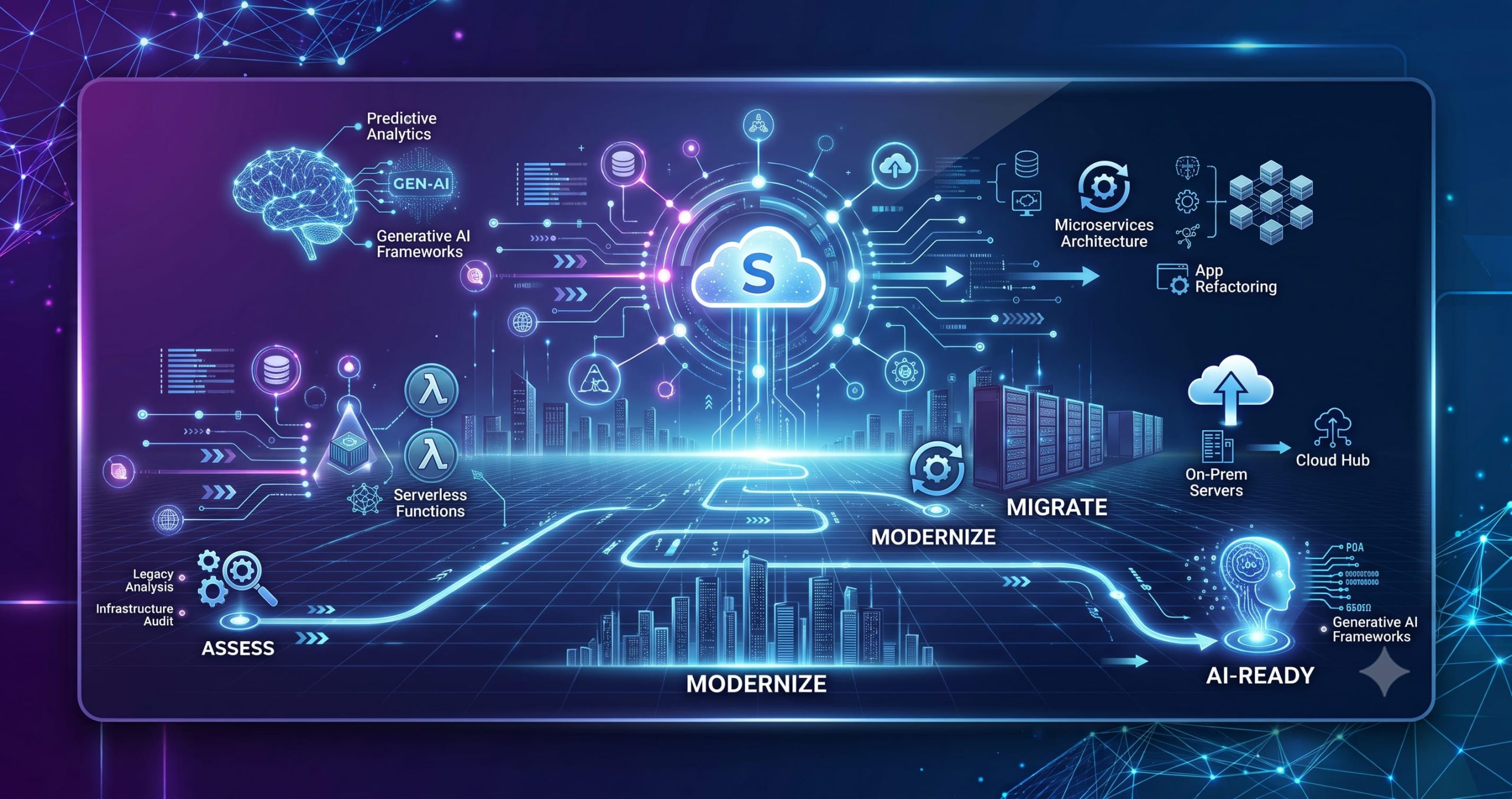
A major reason enterprise transformation projects fail is that operations outpace organizational alignment. Slapping advanced AI or ML on siloed, outdated legacy infrastructure seldom translates into the business outcome of continued expansion-it only adds complexity, risk, and technical debt.
For CIOs, CTOs, and operations leaders, long-term resilience requires rethinking how systems, data, and digital resources are managed.
By 2026, cloud modernization is no longer an IT initiative – it is a business imperative. Organizations that want to scale, support AI adoption, and remain competitive need a cloud strategy that aligns technology, operations, and governance. Lasting transformation comes from breaking down silos, modernizing legacy systems, and building secure, data-driven workflows.
In this guide, you will learn: why cloud modernization is the backbone of digital transformation, why legacy systems need modernization, not just migration, and a practical step-by-step plan to create an AI-ready cloud infrastructure.
What Is Cloud Modernization?
Cloud modernization refers to the disciplined approach to transforming your traditional legacy software and legacy system architecture into cloud native, so as to achieve higher scalability, resilience, and improved operating efficiency. It’s not the same as lift and shift; in a word, it rebuilds the architecture and stack in a totally new way.
To understand the strategic value of this process, executive leaders must distinguish between simple migration and complete modernization.
Cloud Migration vs. Cloud Modernization: The Practical Divide
“Lift-and-Shift” cloud migration lifts existing on-premises applications and moves them to cloud hosting without changing the code or architecture. Although it might rapidly scale back the on-premises physical footprint, it retains the current software bugs, monolithic inefficiencies, and out-of-date databases. Moreover, such a migration to cloud hosting often has greater ongoing cloud costs than might otherwise be the case and fails to exploit new cloud capabilities.
Instead, it’s about refactoring, re-architecting, or replacing those existing systems with more resilient, cloud-native platforms, like breaking down larger, monolithic systems into microservices, containerization, and building centralized, controlled database environments. In so doing, organizations ensure their technology stacks are more effectively aligned to achieve the right business results, with all the flexibility and scalability the organization needs.
This evolution in structure is vital for enterprises that have already migrated beyond a static legacy application transformation towards an intelligent, active operating system.
| Dimension | Cloud Migration (Rehost) | Cloud Modernization (Refactor/Rebuild) |
| Operational Approach | Moves legacy code “as-is” to cloud environments without code alteration. | Rebuilds and optimizes legacy systems for cloud-native ecosystems. |
| Architectural Depth | Preserves existing monolithic bottlenecks and software flaws. | Resolves structural constraints, migrating workloads to modular microservices. |
| Cost Efficiency | High long-term hosting costs due to inefficient resource utilization. | Low, demand-driven operational expenditures with dynamic resource allocation. |
| AI and Automation Readiness | Limited access to advanced analytical databases and machine learning frameworks. | Native integration with centralized data lakehouses and predictive models. |
| Workload Scalability | Rigid architecture blocks rapid processing and multi-site deployments. | Unlimited horizontal and vertical scalability supported by containerization. |
Why Cloud Modernization Matters for AI-First Enterprises
Business leaders at many large companies expect to use Generative AI and advanced machine learning to streamline their operations.
However, deploying AI without a modernized cloud infrastructure is like building a premium vehicle with a fragile engine. The algorithms require massive computational power, real-time data access, and highly secure environments that legacy setups simply cannot support.
An AI-ready cloud strategy is crucial to mitigate three main dependencies for enterprises:
Unifying Distributed Data Ecosystems
Enterprise AI relies entirely on data quality and accessibility. Monolithic, on-premises ERP and CRM systems maintain data in isolated, disconnected databases. This fragmentation prevents machine learning models from accessing a complete, real-time dataset. Cloud modernization establishes governed data systems that integrate disparate data streams into a unified, cloud-native repository. This single source of truth ensures that predictive systems analyze clean, standardized data.
Scaling Computational Capacity Dynamically
Generative AI or other types of advanced AI models need immense amounts of data to process. Old on-prem systems are not flexible. Any required scaling involves buying costly equipment, some of which sits idle at other times. Cloud platforms provide flexible elasticity to burst on to accommodate resource needs and then shrink back to avoid waste.
Securing Sensitive Enterprise Information
For an AI system to produce meaningful insights, it needs access to sensitive company proprietary information. However, accessing this data through uncontrolled distributed networks exposes companies to significant compliance and security risks. The migration of existing on-premises IT to modern cloud infrastructure allows companies to place all of this enterprise asset protection and regulatory compliance under one consolidated security model that provides robust access control and automated audits.
Key Pillars of a Successful Cloud Modernization Strategy
The success of an enterprise cloud strategy or a cloud transformation strategy requires a balance between technological architecture and business strategy. Organizations need to address these four fundamental pillars to avoid modernization efforts turning into IT-only projects.
- Application Refactoring and Microservices
Legacy applications are generally constructed as one giant, monolithic unit. When one element of the legacy app fails, the whole enterprise goes dark. To modernize an application architecture, you fragment those large, monolithic blocks into a set of tiny, independently working microservices connected through secured APIs. IT teams can patch, resize, or rewrite individual services without bringing down entire processes, strengthening business resiliency immediately. - Containerization and Orchestration
To standardize modern applications for public, private, and hybrid clouds, developers can leverage containerization tools that wrap application code and their dependencies in sealed containers. These containers are managed and scheduled by an orchestration platform like Kubernetes, which streamlines the deployment, scaling and operation of applications. - Unified Cloud Data Management
Data quality determines how well an AI runs. Smart cloud modernization roads for retail and enterprise must have a cloud data management plan from discrete databases to the cloud, leveraging a fully managed cloud-native data warehouse or a cloud-native data lake with consistent naming conventions, automated clean up, and enforced data governance. All too frequently, AI models can’t run and yield garbage without it. - Zero-Trust Security and Compliance
More integrated and automated cloud ecosystems mean more attack surfaces. Traditional cloud strategies leave outdated perimeter models behind for a zero-trust architecture, where every request, both inside and outside the organization, needs authentication, authorization and ongoing validation. Automated compliance management helps enterprises achieve the standards they need without ongoing human effort.
Enterprise Cloud Transformation Roadmap
Successful, modern, and AI-ready cloud deployment starts with rigorous, structured execution. They should adhere to a systematic, phased cloud modernization journey in order to maintain business continuity and meet business goals when performing technology upgrades.
Phase 1: Strategic Alignment and Executive Vision
The first phase revolves around aligning the modernization strategy with business objectives. The leaders will have to answer the business objectives they aim to achieve – increased scalability, reduced IT capital investment, or greater operational agility.
Identify Operational Metrics: Set initial baseline of your system up-time, process speeds, and infrastructure costs for measuring future ROI.
Define Strategic Scope: Set up baseline measurements for system uptime, data processing time, infrastructure costs to use as a future ROI benchmark.
Phase 2: Technical Assessment and Architecture Mapping
The IT team should review the entire infrastructure as well as the legacy application dependencies before writing any code or data.
Map System Dependencies: Document how legacy applications communicate and share data to prevent unexpected system failures during modernization.
Select Pilot Workloads: Find low-risk, high-value workloads to act as first pilot modernization efforts to test the waters.
Phase 3: Foundation Building and Data Governance
This phase establishes the security, governance, and data infrastructure required to support cloud-native operations and AI tools.
Deploy Cloud Landing Zones: Create ready-made, pre-configured cloud environments including access controls, network policies and security logs.
Implement Governed Data Lakes: Standardize and centralize core business datasets into managed cloud environments, establishing a single source of truth.
Phase 4: Application Modernization and Integration
With the foundation established, development work can begin the refactoring process and rebuilding of legacy systems.
Refactor Monolithic Applications: Rebuild legacy applications as modular microservices, placing them into managed containers for reliable execution.
Establish Robust APIs: Create secure API networks that allow modernized systems to communicate instantly with internal and external databases.
Phase 5: AI Integration and Business Enablement
With modernized systems and unified data, the enterprise can confidently deploy advanced analytics and machine learning models.
Integrate Predictive Systems: Connect AI tools to the modernized data lake to run predictive demand forecasting, automated procurement, and operational modeling.
Launch Generative AI Frameworks: Safely implement Generative AI tools to streamline internal workflows and ensure security and data quality by understanding the underlying cloud environment.
Phase 6: Continuous Optimization and Scalability
Modernization is not a one-time project; it is a perpetual state of being.
Audit Cloud Spend: Use your cloud management software to manage your costs by ensuring that resources can be automatically allocated according to actual demand.
Refine Predictive Models: Monitor the performance of AI algorithms and continuously tune them to ensure they provide accurate decision support.
Common Challenges and How to Overcome Them
Even with a detailed cloud transformation roadmap, enterprise decision-makers often face implementation realities that can threaten progress. Navigating these obstacles successfully requires strategic planning and realistic execution.
Managing Technical Complexity and Disconnected Systems
Legacy systems rely on custom integrations and old code for their existence. These are a real pain to try to disentangle, as this risks breaking your business.
The Solution: Avoid attempting a rapid, multi-system overhaul. Rely on cloud modernization best practices by using a phased transition. Leave non-critical legacy systems in place temporarily, using secure APIs to bridge the gap between legacy and cloud-native workloads while you transition systems systematically.
Balancing Cost Volatility and Cloud Spending
Although modern technology decreases the physical maintenance infrastructure costs, the unexpected month-to-month bill could possibly reduce your expected ROI due to ill-configured clouds.
The Solution: Reinforce resource management policies with cloud infrastructure. Test environments need to be configured to go offline after business hours automatically and take advantage of committed-use discounts where possible for stable, predictable workloads.
Overcoming Workforce Skills Gaps and Change Resistance
IT staff who’ve been doing things the old way may not have the skills necessary to transition to cloud-native microservices and zero trust, resulting in delays and integration issues.
The Solution: Concentrate on change management and on going technical training. Work with transformation specialists who can give you advice, while sharing knowledge and enabling you to develop an ongoing capability in-house.
How Solutionara Helps Enterprises Build an AI-Ready Cloud
Solutionara is a digital transformation and AI consulting partner offering best-in-class strategy coupled with robust, embedded execution. Enterprise leaders don’t need more buzz; they need more confidence in transformation, scalable architecture and assurance of execution.
In line with our SIGHT philosophy, we work hand-in-hand with IT and business executives to ensure that technology decisions become clear and decisive. We connect strategic advice with pragmatic implementation to make sure that cloud modernization serves your future.
Our Cloud Modernization and AI-Ready Capability Matrix
We enable enterprises to achieve scalable and resilient operations by providing focused solutions in four key areas of modernization:
- Strategic Mapping and Architecture Audits: We conduct comprehensive assessments of your legacy IT footprint, identifying structural bottlenecks, data silos, and technical debt to construct a tailored cloud modernization roadmap.
- Unified Data Governance and Cloud Integration: We break down fragmented data ecosystems and build governed cloud databases that provide the trustworthy, clean and secure single source of truth AI tools need.
- Modular Application Refactoring: We rewrite and extract monolithic, stubborn applications into scalable, cloud-native microservices and containerize workloads to ensure robustness.
- Continuous Optimization and Performance Management: We deploy cloud-cost management systems and continuously tune predictive AI models, ensuring your digital infrastructure scales smoothly to support organic growth.
Working with Solutionara, you gain a dependable execution partner that comprehends your operational realities, handles implementation risks diligently, and enables you with business-focused digital solutions that are safe, scalable and tailored for your needs.
Frequently Asked Questions
Can cloud modernization be implemented without migrating all applications?
Yes. The majority of organizations are adopting hybrid IT by modernizing their critical high-value workloads, while leaving key existing applications within private clouds and/or the enterprise to be accessed via secured APIs.
What is the difference between cloud modernization and digital transformation?
Cloud modernization upgrades IT infrastructure and applications for the cloud, while digital transformation uses that modern foundation to improve business processes, customer experiences, and innovation.
What technologies are used in cloud modernization?
Popular tools, like microservices, containers using Docker, orchestrated using Kubernetes, cloud-native databases, serverless technology, and automated DevOps pipelines, are used for enhanced scaling, execution, and process efficiency.
How does cloud modernization improve data quality for AI?
It centralizes data, breaks down data silos, applies governance, standardizes the data and creates a single clean, authoritative dataset to enhance the accuracy of AI.
Which industries benefit the most from cloud modernization?
Industries with complex operations and large datasets—such as retail, financial services, logistics, healthcare, manufacturing, and FMCG—gain the greatest benefits from improved scalability, agility, and efficiency.
Why should businesses modernize the cloud before adopting Generative AI?
Generative AI needs the data it can learn from and scalable infrastructure to run. Cloud modernization can offer the secure, governed and high-performing infrastructure required to confidently deploy AI.
Contact Us
Your Vision, Our Expertise — Let’s Collaborate
Solutionara partners with businesses that face limited IT capacity, helping them tackle complex technology challenges with ease. Through a blend of strategic consulting and execution expertise, we deliver solutions that drive impact across industries, including retail, grocery, eCommerce, fintech, and supply chain.