For Your Business
How Automation in the Retail Industry Is Driving Growth in 2026
How Automation in the Retail Industry Is Driving Growth in 2026
Many modernization initiatives fail because technology implementation is disconnected from operational strategy and corporate execution. In a highly competitive retail era, relying on disconnected systems and legacy infrastructure forces organizations into a reactive posture, directly threatening long-term enterprise resilience.
Today’s leaders are coping with fluctuating supply chains, evolving customer needs, and compressed profit margins. To ensure their future digital survival, enterprise brands must go beyond out-of-the-box software. Real transformation happens only when business strategy, enterprise systems, local operations, and tech execution align perfectly.
By mid-2026, retail automation will no longer be a hypothetical IT experiment in a futuristic scenario. Retail automation is now the operational layer that underpins how retail enterprises exist and scale profitably over time. The underlying layer dictates whether a business will grow or stagnate, and if the old infrastructure can be scaled.
This guide discusses the paradigm shift toward intelligent operations that is impacting retail workflows, the key levers that enable enterprise growth, and actionable roadmaps for architectural implementation. Enterprise decision-makers must transition from a single, project-based IT approach to establishing governed, data-informed workflows across the global retail landscape by breaking down legacy organizational silos.
What Does Automation in the Retail Industry Mean?
Fundamentally, retail automation is the use of sophisticated, integrated systems that automate and streamline key business processes, break down departmental silos, and provide the organization with highly intelligent decision-making capabilities. The transition to a new, business-wide approach based on integrated data and a unified strategy rather than manual data balancing and departmentalized operations has clearly taken place.
Enterprise decision makers looking at automation in retail are observing a fundamental shift in business operations. They are viewing the change from three different perspectives:
• From Reactive Reporting to Predictive Operations: Standard retail supply chain processes are reactive and rely on backward-looking indicators such as stock levels and historical consumption velocity from the last quarter. However, retail digital transformation enables proactive, controlled data processes that diagnose supply chain bottlenecks, anticipate regional demand peaks, and redirect inventory in advance of stockouts.
• From Fragmented Silos to Integrated Workflows: Traditional retail systems utilize siloed and individual applications such as POS (point-of-sale), HR (human resources), warehouse, and procurement. Automation of retail processes minimizes these functional silos by providing an end-to-end enterprise architecture, where the upstream updates will be automatically synchronized with digital commerce availability on local brick-and-mortar delivery.
• From Human Guesswork to Decision Intelligence: The amount of data from an omnichannel retail strategy is far too vast for human analysis and, therefore, for use in real-time pricing changes or distribution optimizations. When strategically deployed, AI in retail systems fast-tracks modernization without supplanting human analysis. Used in retail, AI is a hub of operational intelligence, producing data-driven, real-time suggestions for executives.
7 Ways Automation in the Retail Industry Is Driving Growth in 2026
The difference between futuristic digital retail brands and traditional IT-centric companies, in particular, is now a significant market competitive barrier. The true effects of innovative automation solutions for retail brands are observable across seven key business vectors.
1. Inventory Automation and Predictive Restocking
Inventory mismanagement is the main reason for retail margin bleed. When financial numbers are pulled using manual data constructs, the buying team is continually dealing with a data void in the organization and is thus at risk for stockouts or inventory holding costs.
Inventory automation applies intelligent machine learning algorithms to expansive datasets, ensuring that high-demand items are replenished proactively.
• Intelligent algorithms continuously analyze variables such as historical sales velocities, regional weather patterns, social trends, and supplier lead times to maintain optimal stock depths.
• Automated reordering processes establish scalable workflows that significantly reduce the manual administrative burden on corporate procurement teams.
• Workflow intelligence improves working capital efficiency by transitioning inventory operations from historical reporting to predictive capability.
Industry experts suggest that tier-one retailers utilizing the benefits of predictive restocking have seen 10% to 15% improvement in inventory carrying costs and 2% to 5% improvement in on-shelf availability, thus recouping lost revenues without the added warehousing space.
2. Retail Workflow Automation in Supply Chain Logistics
The global retail supply chain still has a long way to go before it’s robust. Without integrating backend systems and the operational data layer, enterprises encounter constant implementation problems across their other ecosystems and are unprepared for any disruptions in the supply chain.
Retail workflow automation connects disparate supplier networks, internal distribution centers, and third-party logistics (3PL) platforms into a single, governed data ecosystem.
• Intelligent systems enable automated order routing based on real-time inventory availability mapped across a multi-node fulfillment network.
• Work orders automatically redirect to backup nodes when the main fulfillment center has a local processing delay.
• Retailers can autonomously utilize physical storefronts as distributed micro-fulfillment centers without requiring manual administrative intervention.
This operational intelligence gives you an always-on delivery stream, optimal shipping costs, and the ability to safeguard the customer lifecycle.
3. Customer Experience Automation Across Omnichannel Touchpoints
Today’s customer expects an integrated, consistent customer experience regardless of whether they are using the mobile app, desktop environment, or interacting in a brick-and-mortar store. The old infrastructure was almost never designed to have continuity, so a disparate customer experience resulted.
Customer experience automation bridges these touchpoints, ensuring that activity on a consumer app instantly triggers real-time data synchronization with the in-store experience (and vice versa).
• Automated personalization engines analyze browsing history, historical purchase patterns, and localized inventory data to serve highly targeted product recommendations.
• Organizations can deploy AI-driven customer service systems to autonomously resolve high-volume, routine fulfillment inquiries, such as real-time order tracking and return processing.
• Intelligent automation frees customer-facing associates to concentrate on high-value interactions, driving brand loyalty and store efficiency.
By automating repetitive engagement workflows, retail brands successfully scale support operations without experiencing a proportional increase in administrative headcount.
4. Smart Retail Technology in Physical Stores
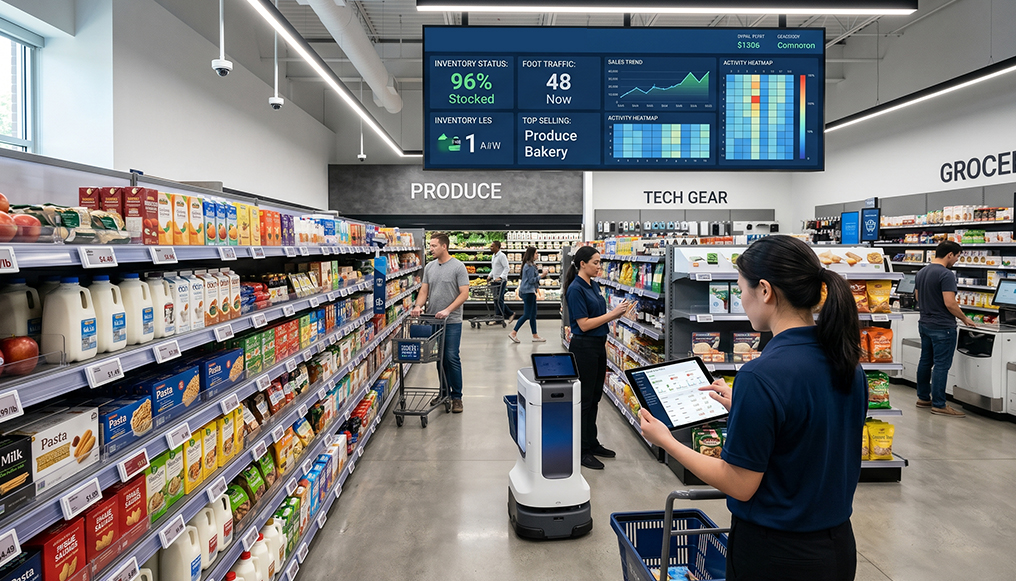
Physical retail is rapidly evolving its basic operating system. The shop is no longer a place for products and a stage for products, but an operational space supported by data. Smart retail means brick-and-mortar retail is not about physical space but about bridging the digital and physical worlds.
• ESLs facilitate real-time, simultaneous updates of prices to tens of thousands of stores, with significant savings in labor cost versus traditional paper tagging.
• Computer vision systems and Internet of Things (IoT) sensors monitor product shelf health in real-time.
• Automated notifications alert floor associates the moment high-velocity items require replenishment from the back stockroom.
These automated workflows minimize friction for consumers while providing corporate leadership with the granular operational visibility needed to accurately evaluate store-level unit economics.
5. AI in the Retail Industry for Dynamic Pricing Strategies
For retailers, extreme agility is demanded by fluctuating markets and competitors’ aggressive pricing. Rigid pricing strategies lead to both lost market share in slumps and excessive margin erosion in upswings. Price changes for hundreds of thousands of SKUs are practically impossible for today’s enterprise teams to perform by hand at scale.
Deploying AI in retail industry pricing strategies allows enterprises to establish dynamic, intelligent revenue models.
• Intelligent systems continuously monitor and evaluate competitor pricing movements and localized demand signals.
• The system cross-references current inventory depth and seasonal variances to dynamically adjust prices within strictly defined corporate boundaries.
• This scalable enterprise execution maximizes yield and profitability on a granular, per-item basis.
Coupled with a robust automation governance model, dynamic pricing engines enable an organization to respond to shifting market conditions far faster than traditional human analysis can.
6. Retail Process Automation in Back-Office and HR Operations
Although digital transformation projects are often centered on acquiring new customers and front-end supply chains, back offices in corporations present great opportunities for increased efficiencies. Manual administrative tasks are time-intensive. Automation of retail processes aims at the most high-friction, repetitive administrative work within the enterprise.
• Leveraging workflow intelligence allows companies to streamline automated invoice reconciliation, ensuring vendors are paid accurately and within terms.
• Automation simplifies complex, large-scale payroll processing and employee onboarding across enterprise-scale business units.
• For retailers managing large volumes of seasonal associates, automated workflow systems optimize credentialing, corporate training distribution, and dynamic shift scheduling.
Streamlining these back-office processes enables you to unlock administrative human capital and reinvest that effort in developing your workforce and aligning your business strategy.
7. Automated Retail Operations for Shrinkage and Fraud Prevention
Shrinkage is a billion-dollar problem for most corporations’ operations. Based on NRF baseline data reports, the shortfall can be attributed mostly to internal theft, administrative errors, and organized retail crime (ORC). Currently, typical loss-prevention practices, such as post-mortem investigations, only measure capital losses after they have been incurred.
Automated retail operations provide a sophisticated layer of defense through continuous operational oversight.
• Transactions are continuously audited for operational anomalies using real-time point-of-sale (POS) data streams combined with advanced edge video analytics.
• Automated flags instantly catch high volumes of voided items, suspicious return profiles, or unauthorized stacking of promotional discounts.
• With governed data networks, retailers can actively investigate fraud patterns internally and externally before there is a large loss of capital.
The decision intelligence transforms the risk mitigation process from a post-mortem investigation procedure to a proactive, real-time operational control, making the enterprise more robust.
Best Practices for Successful Retail Automation
Enterprise buyers do not invest based on marketing hype—they invest based on trust in strategic capability and maturity of execution. Adopting intelligent corporate systems requires a clear governance structure and a coherent roadmap that protects enterprise stability. Corporate leaders driving an enterprise-wide transformation should adhere to the following implementation principles:
• Prioritize Strategic Alignment Over Technology Trends: Investment in technology has to have a clear link to operational metrics. Implementations that use AI or automation simply to feel ‘current’ create fragmentation across applications, and the investment is not worthwhile. Management needs to identify an operational challenge before looking for automation solutions.
• Stabilize Legacy Infrastructure and Establish Data Governance: Automated systems and intelligent algorithms are incapable of analyzing data that is fragmented, unverified, or incomplete. Organizations need to cleanse the accumulated technical debt within their enterprise architecture prior to implementing advanced automation levels. Unregulated data that lies trapped within departmental siloes cannot yield trusted automated outputs.
• Plan for Scalable Execution and Phased Rollouts: Operational disruption is a significant threat to the replacement of the retail technology foundation. Organizations that perform full-scale, system replacement at a global scale will assume extreme operational liabilities. Adopt a phased approach to adoption; use and pilot automation in isolated test environments; identify and test exception handling; ensure performance; then roll out globally.
• Emphasize Automation Governance and Human Oversight: Position automation as a tool for operations and not a substitute for human decisions. Define clear corporate governance guardrails to ensure digital operational agility does not override corporate compliance and C-suite buy-in. AI-driven decision intelligence must be used to determine the best operational paths, while a human is used to make the final decisions on the high-level exceptions and strategic decisions.
The Future of Automation in Retail
The future of retail automation appears to be extremely dynamic, self-orchestrating environments. With global brands replacing their large legacy systems with scalable cloud native systems, the time taken for businesses to consume new data and implement changes to their business will dramatically increase.
Retail modernization over the coming cycles will heavily feature deep-tier edge computing within physical stores. This architecture will power low-latency IoT networks and intelligent shelving arrays, enabling on-premises data processing, for instance, autonomous actions.
Enterprise AI will move from simple automation to orchestrating the entire commerce ecosystem. It will have the supply chain networks, dynamic pricing engines, and the customer experience interfaces seamlessly work together. Businesses investing in governed, scalable data architectures now will be best poised to lead in the future of intelligent commerce.
How Solutionara Helps Retailers Accelerate Automation
Solutionara is not a technology supplier; we are a strategic, consulting-driven technology company that helps enterprise executives realize operational transformations. We know that consulting on digital transformation is more than the ‘why’ and more than the ‘how’–it’s about the “how.”
Many retailers struggle with outdated technology, fragmented data repositories, and difficult compliance requirements. Solutionara offers an end-to-end approach, tying a strategic high-level modernization plan with technical software deployment to generate tangible business value for your AI and process automation efforts.
Our methodologies eliminate operational silos, construct secure enterprise data governance frameworks, and implement intelligent systems that fuel scalable corporate growth.
Discover how intelligent transformation can support your corporate objectives. Contact the Solutionara enterprise tech team today to initiate a scale-ready operational blueprint.
Frequently Asked Questions
What retail processes should businesses automate first?
Repetitive, high-friction, error-prone operational activities are perfect candidates for most retail businesses to begin the transformation. Order routing automation, AP invoice processes, and warehouse network-wide inventory recs. Automating these “floor-level” activities puts the wheels on the base vehicle, provides a fast ROI, and frees up the internal human resources for more valuable, strategic work.
How much does retail automation cost for mid-sized and enterprise businesses?
The capital allocation required for retail automation varies depending on the state of existing legacy infrastructure and the overall scope of the modernization strategy. Rather than evaluating automation as a flat software licensing cost, organizations should view it as an investment in corporate operational transformation. Utilizing cloud modernization frameworks and scalable SaaS architectures allows companies to deploy phased, modular rollouts, ensuring implementation costs align directly with realized efficiency gains and measurable business outcomes.
What are the biggest mistakes retailers make when implementing automation?
Perhaps the most significant failure is applying technology that is isolated from the business operational plan. Common problems that may cause disruptions include: Automating ill-defined processes, ignoring data governance standards, and under-investment in workforce change. Automating operations in a silo does not generate enterprise agility; it generates technical debt.
Can retail automation integrate with existing ERP, POS, and inventory systems?
Yes, provided the enterprise architecture has been explicitly designed for interoperability. Enterprise-grade automation solutions connect legacy ERP software (such as SAP or Oracle) with modern point-of-sale (POS) systems and third-party logistics networks. This is achieved by building unified integration layers that utilize modern RESTful and GraphQL API frameworks, combined with cloud-native microservices and real-time data streaming engines such as Apache Kafka, to form a comprehensive, governed data layer.
What KPIs should retailers track to measure the success of automation?
Enterprise leaders should be measuring key performance indicators directly associated with scalable growth and operational efficiency to determine if modernization efforts provide a good return on investment:
• Rate of inventory turnover
• Number of out-of-stock and stockout occurrences
• Time for the cycle of order fulfillment
• Total hours spent on labor for data entry
Customer retention and the more general operational visibility metric should also be considered by the enterprise brand to better quantify the total business benefit.

Contact Us
Your Vision, Our Expertise — Let’s Collaborate
Solutionara partners with businesses that face limited IT capacity, helping them tackle complex technology challenges with ease. Through a blend of strategic consulting and execution expertise, we deliver solutions that drive impact across industries, including retail, grocery, eCommerce, fintech, and supply chain.